Posts

Erosion and Sediment Control Tip #36
Image
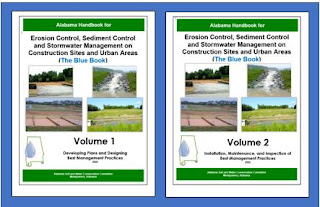
  This may be my best E&SC Tip yet.   The 2022 Version of Alabama’s Erosion and Sediment Control Handbook (The Blue Book) is now available electronically.  Click on the following links to get Volume 1 or 2:   2022 Blue Book Volume 1   2022 Blue Book Volume 2   The Introductory section of each Volume of the Blue Book contains the Major Changes, New Content, and Major Clarifications since the 2018 version was published.   Enjoy.   Perry L Oakes, PE Erosion and Sediment Control Program Coordinator AL Soil and Water Conservation Committee

Erosion and Sediment Control Tip #35

Image
  Just as this picture clearly shows that a paving job is a “Process” if done correctly, erosion and sediment control on a construction site should be a process.   E&SC practices must be properly planned, correctly executed (sequenced), correctly installed, adapted as needed based on site conditions, and properly maintained for the life of the practices.   When E&SC is executed with a “Process” in mind, our soil can be kept on-sight and our construction stormwater clean.   Perry L Oakes, PE Erosion and Sediment Control Program Coordinator AL Soil and Water Conservation Committee

Erosion and Sediment Control Tip #34

Image
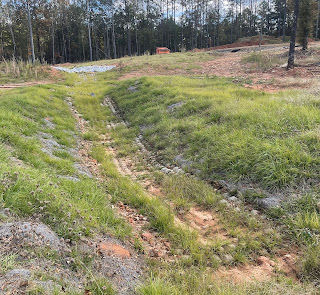
  I’m going to get on my soapbox again:   Those who know me, know that I spent over 35 years with USDA/NRCS working with private landowners to help them solve natural resource issues on their property.  My former co-workers and I have often stated that you can determine how well a property owner is going to maintain conservation practices by taking note of the general appearance of the farm.  Now that I have worked a few years in the Erosion and Sediment Control world, I believe the same can be said about erosion and sediment control practice installation and maintenance on a construction site.  Sites like this one shown here should NOT be happening in 2022!   Perry L Oakes, PE Erosion and Sediment Control Program Coordinator AL Soil and Water Conservation Committee

Erosion and Sediment Control Tip #33

Image
  As a professional in the Erosion and Sediment Control Industry, it is important for each of us to take the time and make the effort to share our knowledge with others.  Whether it is giving a presentation at a technical meeting, sharing information with our co-workers, or sharing with the youth in our world.  How many have taken the time to explain to their kids or grandkids the importance of being a good steward of our natural resources.  So, Teach ‘em Young!  It’s important for the next generation to carry on with the work we do.     Perry L Oakes, PE Erosion and Sediment Control Program Coordinator AL Soil and Water Conservation Committee

Erosion and Sediment Control Tip #32

Image
  There are many Sediment Control Practices that require the captured sediment to be removed and properly disposed of when ½ of the sediment storage volume has been reached.  First, if you are having to deal with sediment removal on your construction site, you should look upslope and fix the erosion control methods and practices.  However, if you must remove sediment, do so without destroying the sediment control practice. Where is the location for placement of the sediment and how should it be “properly” disposed of?  Most likely the sediment will be saturated.  This requires the material to dry out somewhat before it can be stabilized.  Locate a good area on the jobsite.  Preferably a site with good vegetation downslope and not near a receiving stream.  If there is no vegetation that could serve as a grass filter, then you’ll probably need to install a silt fence to control the runoff. Stack the removed sediment as much as it will stack and let ...

Erosion and Sediment Control Tip #31

Image
  Many of the Erosion Control Products like Rolled Erosion Control Blankets, Turf Reinforcement Mats, tied concrete block mats, and other manufactured products rely on vegetation for permanent stabilization.  This means that the soil underneath these products must be of the quality to support vegetation.  Eric Marsal of the American Excelsior Company and John Slupeki of Motz Enterprises Inc. (Flexamat) have helped me develop the following list of things to remember about getting vegetation established for these erosion control  products:   Take a soil test to know the lime and fertilizer requirements. Eliminate compaction problems.  Roots can’t penetrate compacted layers. Caution: DON’T rip the soil in the direction of flowing surface water.  This can result in erosion.  Rip or disc the soil perpendicular to water flow if possible. Rototilling can be done in either direction. Correct a low pH by INCORPORAT...

Erosion and Sediment Control Tip #30

Image
  You have often heard us talk that an Erosion and Sediment Control Plan for a construction site should be “Site Specific”.  That’s because every site (even a small home site lot) is a little different from the other sites.  So designers should be careful and not use what I call “cookie cutter” plans for erosion and sediment control.  While the plans can be similar and have some of the same features, the plans should meet the requirements for the specific location. Make sure your plan is ON TARGET.   Perry L Oakes, PE Erosion and Sediment Control Program Coordinator AL Soil and Water Conservation Committee