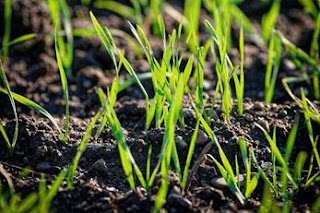
Establishing perennial vegetation by seeding is by far the most economical way to get permanent vegetative cover on a site. But it not only has to be done right (seedbed preparation, lime, fertilizer, etc.) but the seed must have a good chance to germinate and grow prior to its dormant period. The species of seed selected for a project has its own recommended seeding dates. The closer you get to the ending date, the more potential for the vegetation to not survive its period of non-vegetative growth. For warm-season perennial vegetation (Bermudagrass, Bahia, etc.) the non-vegetative growth period is the cold winter months, while the non-vegetative growth period for the cool season perennial vegetation (Tall Fescue) is the hot summer months. The vegetation needs to germinate (energy from the seed), and have plenty of time to grow and photosynthesize to provide the energy for the roots. The stored energy in the roots is what allows the plant to v...
On some construction jobs, temporary access across a stream or drainageway is needed. Rather than taking construction equipment through the stream, it is always best to use a temporary bridge if possible, or a culvert crossing as a second option. Always protect the aquatic environment. Perry L Oakes, PE Program Coordinator AL Erosion and Sediment Control Program
In order to control erosion on a construction site, you must first understand the erosion process. Rainfall and the surface runoff of rainfall produces four main types of erosion on a construction site: Splash Erosion occurs when the raindrop impacts the bare soil surface and dislodges soil particles. Sheet Erosion occurs either after the surface of the soil is saturated or the rainfall exceeds the infiltration rate of the soil. Then the soil detached by splash erosion and the additional soil particles detached by runoff/overland flow move downslope. (Note: Splash and Sheet are sometimes referred to as Interrill Erosion ) Rill Erosion occurs when the sheet flow concentrates and causes small rills (about 1 inch deep) further eroding the soil surface. Gully Erosion occurs when runoff water in a rill detaches more soil and deepens and/or widens the channel to a significant size. (Note: There is no universally recognized dep...



Comments